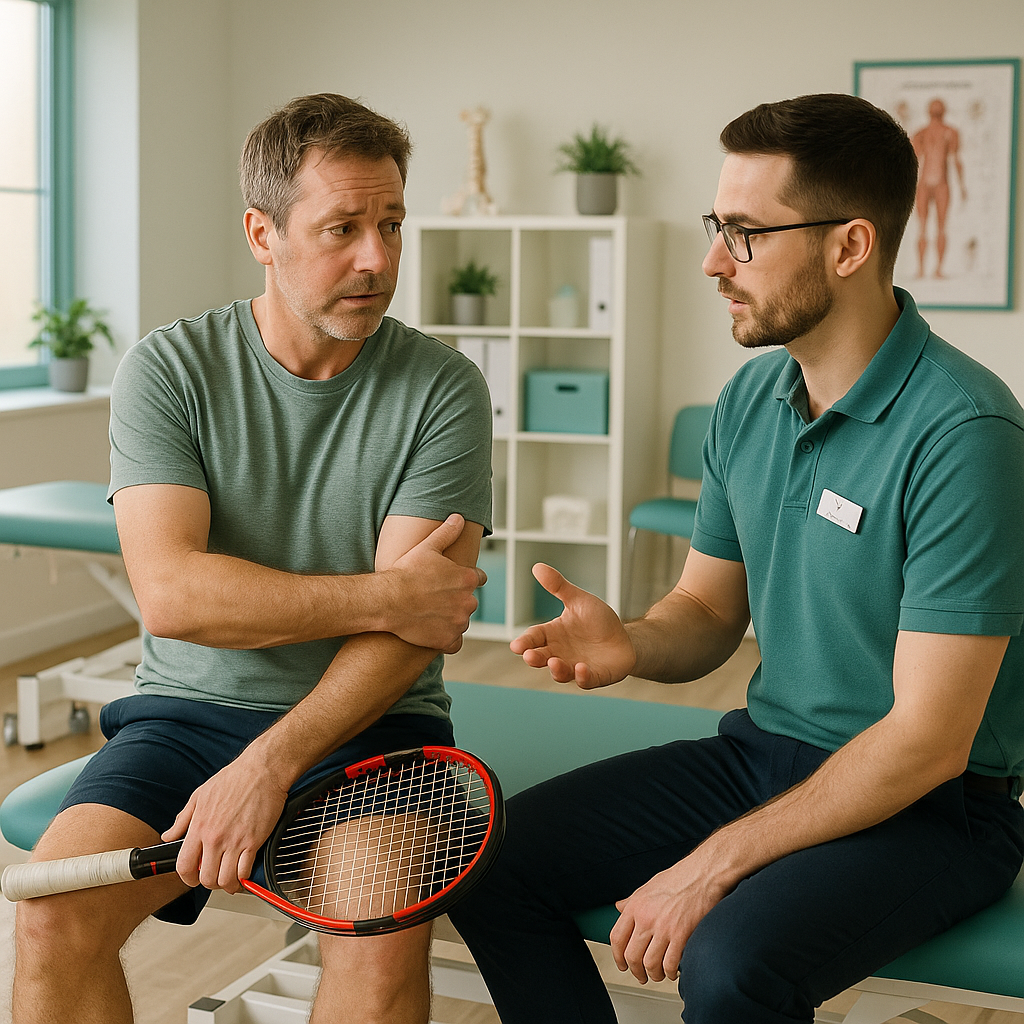
Only 5% of people suffering from tennis elbow relate the injury to tennis. This injury occurs in other racket sports such as squash, badminton, and table tennis. Golfers can also be affected as well as those who carry out repetitive, one-sided movements in their jobs or leisure activities. The disorder represents a degenerative process that is secondary to tensile overuse fatigue, weakness and possibly avascular changes.
Symptoms and Diagnosis
- There is history of repetitive activity or overuse.
- Pain mainly affects the lateral aspect of the elbow but can also radiate upwards along the upper arm and downwards along the outside of the forearm.
- Weakness in the wrist can cause difficulty in carrying out such simple movements.
- A distinct tender point in elicited by pressure or percussion over the lateral epicondyle
- Pain occurs over the lateral epicondyle when the hand is dorsiflexed at the wrist against resistance.
- A positive middle finger test: there is pain over the lateral elbow when the middle finger is extended against resistance.
Preventive measures
- Correct playing and working techniques are the most important preventive measures.
- Sometimes a forearm brace or a heat retainer can be used as a means of dissipating the forces outwards.
- Asymmetrical training techniques should be avoided
Treatment
The treatment should follow the healing response; this includes three phases: an acute inflammatory phase, a collagen and ground substance production phase, and a maturation and remodelling phase.
The athlete should:
- Reduce pain and inflammation when the injury is in its acute stage by using ice
- Rest the injured area and avoid movements that trigger pain
- Apply local heat when the injury is no longer in its acute stage
- Try taping the wrist to support the elbow joint under load
A genuine tennis elbow often heals spontaneously and the prognosis is generally good. The symptoms can persist for anything from 2 weeks to 2 years especially if the athlete continues to load the arm. Strenuous activity can be resumed when the arm is fully mobile, has regained normal strength and is pain free.
About Ellie Luzar
Ellie Luzar is a practitioner at b2 Chalfont Clinic with extensive experience helping patients achieve optimal health through evidence-based care.
View Full ProfileReady to Start Your Health Journey?
Book a free 10-minute consultation to discuss your concerns
Book Your Consultation